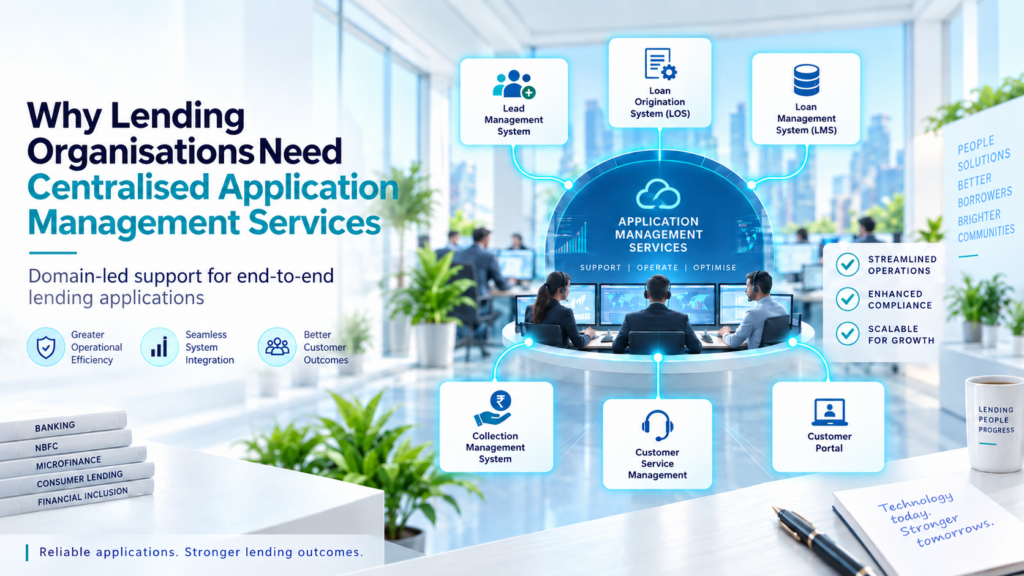
For a lending organization, technology is no longer simply an operational support function. Loan origination, credit assessment, document collection, approvals, disbursement, repayment management, collections and customer servicing all depend on multiple interconnected applications working reliably every day.
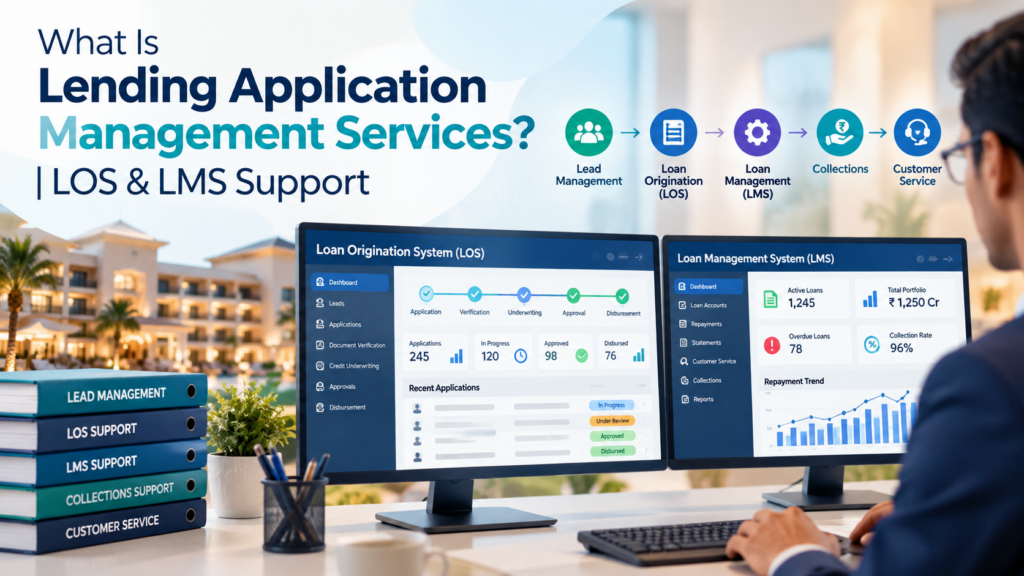
A sales executive may be using a Loan Origination System to create an application. The credit team may depend on integrations with bureau and KYC providers. Operations may use the same LOS for approval and disbursement workflows. Once the loan is disbursed, the Loan Management System takes over repayments, charges, receipts, foreclosure and servicing activities.
If even one part of this ecosystem stops working properly, the impact quickly reaches the business. This is where Lending Application Management Services become important.
What Are Lending Application Management Services?
Lending Application Management Services are specialized managed support services for the technology applications used by banks, NBFCs, Housing Finance Companies, FinTech lenders and other lending organizations.
They typically cover applications such as:
- Loan Origination System (LOS)
- LOS on Salesforce
- Loan Management System (LMS)
- Customer Relationship Management systems
- Collections applications
- Customer portals and mobile applications
- Document management systems
- Payment and NACH integrations
- Credit bureau integrations
- KYC, verification and eSign platforms
- Reporting and analytics platforms
- Other connected lending applications
A mature Lending AMS partner may provide everything from L1 and L2 application support to complete application management ownership, including incident management, problem management, SLA monitoring, root cause analysis, vendor coordination, minor enhancements, release support and service governance.
Why Lending Applications Need Specialized Support
Lending applications are different from many general enterprise systems because they are deeply connected with business processes. If a Loan Origination System cannot move an approved application to the next stage, a customer disbursement may be delayed.
An LMS issue may affect EMI schedules, repayment posting, customer account balances, foreclosure calculations, charges, NACH presentation, collections, accounting and customer servicing.
Why domain knowledge matters
Application support for lending organizations requires both technical knowledge and lending-domain understanding. A support engineer should not only understand that a workflow failed—they should understand what that workflow means to the lending process and business user.
Loan Origination System Support
A Loan Origination System (LOS) manages the journey from lead or application creation through credit assessment, approval and often disbursement.
LOS application support services may include:
- Login and access issues
- User roles and permissions
- Application creation issues
- Workflow and approval failures
- Credit-rule failures
- Data-validation issues
- Document-upload problems
- Application-status problems
- Integration failures
- Reports and dashboards
- Notification failures
- Business-user queries
- Production incidents
LOS on Salesforce Support
Many lending organizations use Salesforce as the platform for their Loan Origination System. In such environments, application support requires both lending knowledge and Salesforce expertise.
- Salesforce user administration
- Profile and permission issues
- Role hierarchy
- Flow failures
- Approval processes
- Validation rules
- Apex-related issue coordination
- Lightning component issues
- Reports and dashboards
- Integration support
- Data-quality issues
- Scheduled jobs
- Configuration changes
- Minor Salesforce customizations
Loan Management System Support
Once a loan is disbursed, the Loan Management System generally becomes the system of record for servicing the loan. Common LMS platforms may include Pennant, FinnOne, FinnOne Neo, other third-party LMS platforms and in-house systems.
- Loan-account issues
- Repayment schedule problems
- EMI-related queries
- Receipt posting
- Payment allocation
- Charges and reversals
- Foreclosure and part-payment
- Restructuring
- NACH processing
- Collection-related transactions
- Batch jobs
- Accounting interfaces
- Customer servicing
- LMS integrations
Why LOS and LMS Should Not Be Supported in Isolation
A problem that appears in the LMS may have originated during LOS disbursement. Similarly, an issue visible in the LOS may actually be caused by an external integration. Effective LOS and LMS application support therefore requires end-to-end visibility.
What Does L1 Application Support Do?
L1 application support is usually the first point of contact for business users.
- Receiving and acknowledging tickets
- Understanding and categorizing user issues
- Priority identification
- Basic troubleshooting
- SOP-based resolution
- Known-issue resolution
- User communication and ticket updates
- Escalation to L2 when required
What Does L2 Application Support Do?
L2 application support handles issues requiring deeper functional or technical analysis.
- Detailed incident investigation
- Application log analysis
- Workflow analysis
- Data validation
- Configuration review
- Integration investigation
- Batch-failure analysis
- Root cause analysis
- Workaround identification
- Coordination with development teams and product vendors
- Production-fix validation
- Minor configuration changes
Incident Management in Lending Applications
An incident is any unplanned event affecting normal application operation. Examples include LOS unavailability, stuck workflows, credit-bureau failures, LMS batch failures, payment posting failures, login problems and disbursement-interface failures.
- Incident logging
- Classification
- Prioritization
- Assignment
- Investigation
- Escalation
- Resolution
- User confirmation
- Closure
Problem Management and Root Cause Analysis
Closing an incident is not always the same as solving the underlying problem. A support team may repeatedly restart a failed workflow and close the ticket, while the same issue returns every month.
- Why did the incident occur?
- Has it occurred before?
- Which users or processes are affected?
- Is there a permanent corrective action?
- Is a configuration change required?
- Is an integration unstable?
- Is additional monitoring required?
- Is user training needed?
SLA Management for Lending Application Support
Service Level Agreements help define expected support performance. Typical SLA metrics include response time, resolution time, workaround time, priority-based SLA, ticket ageing, availability and escalation time.
P1 – Critical
Major application outage or severe business disruption.
P2 – High
Important functionality affected with significant business impact.
P3 – Medium
Limited impact or workaround available.
P4 – Low
Minor issue, user query or non-critical request.
Why Month-End Support Matters in Lending
Month-end can be particularly important for lenders because of disbursement processing, collection activities, repayment posting, reconciliation, batch execution, accounting interfaces and reporting.
- Month-end support
- Critical batch windows
- Planned weekend activities
- Production deployments
- Major business-processing periods
Support Governance: More Than a Ticket Dashboard
Daily Operational Governance
- Critical incident tracking
- Pending-ticket review
- SLA monitoring
- User escalation
- Dependency management
Weekly Service Review
- Tickets received and resolved
- Pending tickets and ageing
- SLA adherence
- Major incidents
- Vendor dependencies
- Recurring issues
Monthly Management Review
- Application-support performance
- Ticket-trend analysis
- Root cause analysis
- Improvement opportunities
- Knowledge management
- Automation opportunities
- Service-improvement roadmap
Managed Application Support vs Resource-Based Support
Resource-Based Support
The organization hires individual L1 or L2 resources while retaining responsibility for work allocation, SLA governance, process management, performance monitoring and service ownership.
Managed Application Support
The service provider takes greater ownership of the support team, ticket allocation, SLA, reporting, escalation, RCA, knowledge management, governance and continuous improvement.
Benefits of Lending Application Management Services
- Faster incident resolution: clearer ownership and dedicated support resources.
- Reduced business disruption: fewer unresolved issues affecting sales, credit and operations.
- Lower internal IT workload: internal teams can focus on strategic initiatives.
- Better SLA visibility: management gets clearer support-performance reporting.
- Reduced recurring issues: problem management and RCA reduce repetitive incidents.
- Better user experience: business users receive clearer communication and faster support.
- Stronger vendor coordination: improved coordination across application and integration vendors.
- Scalable support: support capacity can grow with the lending business.
When Should a Lending Organization Consider Managed Application Support?
- High L1 ticket volumes
- Increasing L2 workload
- Large ticket backlog
- Frequent recurring incidents
- High ticket ageing
- Poor SLA performance
- Internal teams spending too much time on support
- Multiple application vendors
- LOS-LMS integration complexity
- Month-end support challenges
- Lack of RCA and service reporting
- Rapid business growth
- Difficulty hiring skilled support resources
Application Support for NBFCs, HFCs and FinTech Lenders
NBFC Application Support
NBFCs may operate multiple lending products and increasingly depend on digital platforms. Managed support can cover LOS, LMS, collections, CRM, customer applications, integrations, reporting and production support.
HFC Application Support
Housing Finance Companies often manage long-tenure loans and complex operational processes involving property, legal, technical valuation, servicing and regulatory reporting. Domain understanding becomes particularly important.
FinTech Application Support
Digital lenders operate highly integrated architectures involving APIs, KYC providers, credit bureaus, eMandate, eSign, payment systems, rule engines and cloud services. Support therefore requires strong coordination across systems.
Role of Knowledge Management
- Standard Operating Procedures
- Known Error Database
- Troubleshooting guides
- Resolution notes
- Application documentation
- FAQs
- Support runbooks
- Integration dependency documentation
How to Choose a Lending Application Management Partner
- Does the provider understand lending?
- Does the provider understand LOS and LMS environments?
- Can the provider support Salesforce-based LOS?
- Does the provider offer both L1 and L2 support?
- Is there structured SLA governance?
- How is RCA managed?
- Can the support model scale?
- Can the provider coordinate effectively with existing vendors?
From Application Support to Application Ownership
How 4everCloud Approaches Lending Application Management
At 4everCloud Technologies Pvt. Ltd., our approach is based on a simple principle: application support should understand the business process it supports.
- LOS application support
- LOS on Salesforce support
- LMS application support
- L1 and L2 application support
- Incident and problem management
- Root cause analysis
- SLA governance
- Vendor coordination
- Month-end support
- Knowledge management
- Continuous service improvement
Technology Resource Augmentation
Some organizations may not initially require a complete managed service. They may simply need additional technology capacity. Alongside AMS, 4everCloud can provide focused resources such as:
- L1 Application Support Engineers
- L2 Application Support Engineers
- Salesforce Administrators
- Salesforce Developers
- Salesforce Business Analysts
- Node.js Developers
- React.js Developers
- Full-Stack JavaScript Developers
Frequently Asked Questions
What are Lending Application Management Services?
Lending Application Management Services provide ongoing support, monitoring, governance and improvement for applications used by lending organizations, including LOS, Salesforce LOS, LMS and connected systems.
What is LOS application support?
LOS application support covers user issues, workflows, configurations, integrations, reports, access, production incidents and other problems affecting the Loan Origination System.
What is LMS application support?
LMS application support covers loan servicing applications used after disbursement, including repayment schedules, receipts, charges, foreclosure, collections, batch jobs and integrations.
Do Lending AMS providers offer L1 and L2 support?
Yes. L1 typically manages user support, ticket triage and known issues, while L2 handles deeper functional and technical investigation.
Can Salesforce LOS be supported under Application Management Services?
Yes. Salesforce-based lending applications can be supported through Salesforce administration, configuration, workflow analysis, integration support, reporting and minor customization.
Can an organization outsource only L1 support?
Yes. Many organizations begin with L1 or selected L1/L2 support and expand the scope later.
Can Application Management Services include month-end support?
Yes. Support coverage can be designed around critical business periods, including month-end and planned weekend activities.
Is Lending AMS suitable for NBFCs and HFCs?
Yes. NBFCs, Housing Finance Companies, banks and digital lenders can use Lending AMS to improve application stability, support governance and business-user experience.
Conclusion
Modern lending organizations depend on technology at almost every stage of the customer and loan lifecycle. As application ecosystems become more complex, relying only on reactive ticket resolution becomes increasingly difficult.
Lending Application Management Services provide a structured way to manage LOS, LOS on Salesforce, LMS and connected lending applications while improving stability, service visibility and business-user experience.
The strongest AMS models go beyond ticket closure. They create accountability, identify recurring problems, improve governance and allow technology teams to spend less time firefighting and more time improving the business.
Looking to strengthen support for your LOS, Salesforce LOS or LMS?
Talk to 4everCloud about a Lending Application Support Assessment to review your current ticket volumes, support model, recurring incidents, SLA performance and opportunities for improvement.
Talk to 4everCloud4everCloud Technologies Pvt. Ltd. · Lending Application Management Services · LOS Support · Salesforce LOS Support · LMS Support